 Alkaline Battery
 Carbon Zinc Battery
 Button Cell Battery
 Primary Lithium Batteries
 Rechargeable Batteries
 Custom Battery Pack
 USB Rechargeable Lithium Battery
The global healthcare landscape is shifting toward decentralized monitoring. Disposable Medical Sensors—ranging from Continuous Glucose Monitors (CGM) to smart cardiac patches—demand a power source that is as reliable as it is compact. At the heart of this revolution lies Lithium Thionyl Chloride (Li-SOCl₂) battery technology.
1. Why Li-SOCl₂ is the Gold Standard for Medical Sensing
In the realm of primary (non-rechargeable) lithium batteries, the Li-SOCl₂ chemistry stands out for its unique performance profile, perfectly aligned with clinical needs:
- Exceptional Energy Density: Boasting up to 650 Wh/kg, these batteries allow sensors to maintain a “band-aid” thin profile without sacrificing operational life.
- Decade-Long Shelf Life: With a self-discharge rate of less than 1% per year, sensors powered by Li-SOCl₂ can remain in hospital inventory for years and perform instantly upon activation.
- Stable Voltage Plateau: Unlike alkaline cells that drop voltage gradually, Li-SOCl₂ maintains a flat discharge curve (typically at 3.6V), ensuring the high-precision Analog-to-Digital Converters (ADCs) in sensors remain accurate until the very last drop of energy.
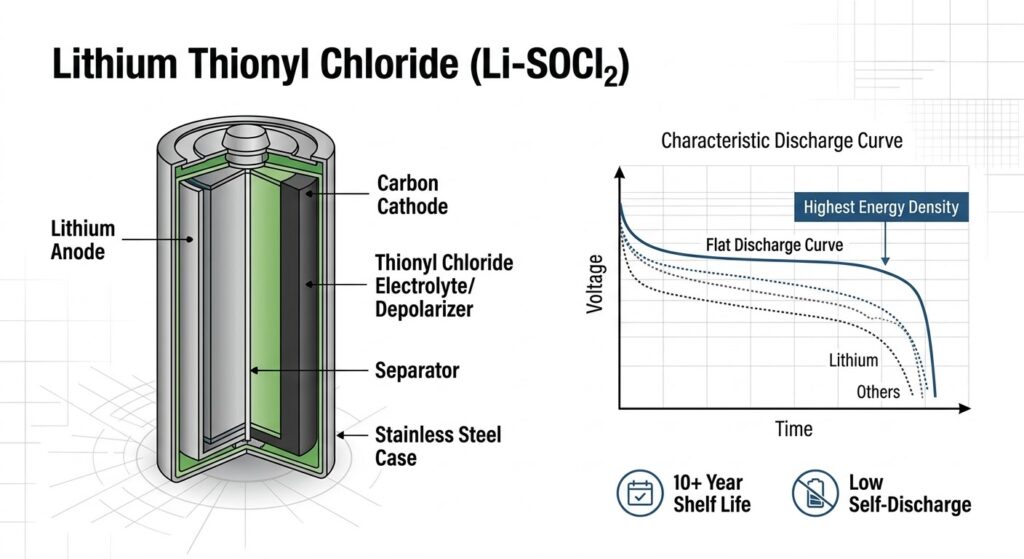
This image details the internal architecture of a Lithium Thionyl Chloride (Li-SOCl₂) cylindrical cell, highlighting the lithium anode, carbon cathode, and the SOCL₂ electrolyte/depolarizer. It visually maps the key advantages: Highest Energy Density, 10+ Year Shelf Life, and Flat Discharge Curve
2. Comparing the Energy Landscape in MedTech
While Li-SOCl₂ leads for long-term patches, other battery chemistries fill vital niches in the medical ecosystem:
| Battery Type | Key Advantage | Typical Medical Application |
| Li-SOCl₂ (Primary) | Highest energy density & longevity | Long-term wearable patches (CGM, ECG) |
| Lithium-ion (Li-ion) | High power burst & rechargeable | Digital endoscopes, powered surgical tools |
| USB Lithium | User convenience & standardization | Handheld diagnostic tools, nebulizers |
| Alkaline / Zinc-Carbon | Cost-effective & widely available | Digital thermometers, simple pen-lights |
3. Overcoming the “Pulse” Challenge
Medical sensors often spend 99% of their time in “sleep mode” (measuring data) and 1% in “active mode” (transmitting data via Bluetooth or NB-IoT). This requires a high pulse current that standard Li-SOCl₂ cells might struggle with due to passivation.
The Solution: Many high-end disposable sensors now utilize a Hybrid Layer Capacitor (HLC) in parallel with the Li-SOCl₂ battery. This “battery-capacitor” duo provides the steady energy for monitoring and the “instant kick” needed for wireless data transmission.
Industry Insight: Safety and Biocompatibility
In the medical field, performance isn’t the only metric—safety is paramount. Modern Li-SOCl₂ batteries for disposables are engineered with:
- Hermetic Sealing: Preventing leakage even under physical stress.
- Biocompatible Housing: Ensuring that even if a wearable patch is compressed, the chemistry remains isolated from the patient’s skin.
Expert Take: As we move toward “Smart Disposables,” the integration of thin-film Li-SOCl₂ will be the catalyst for the next generation of 7-day and 14-day continuous monitoring systems.
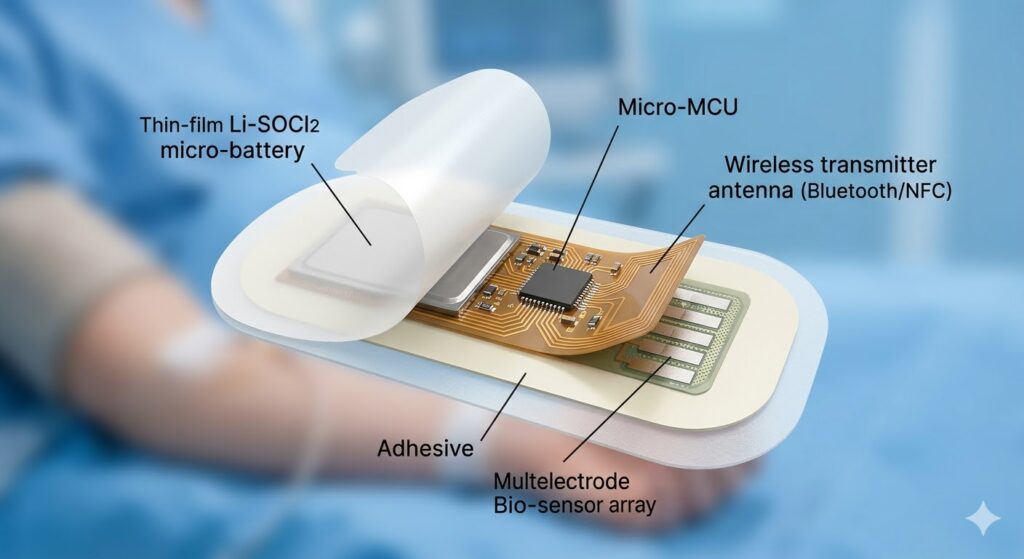
This image zooms in on a wearable, disposable smart medical patch. By peeling back the flexible layers, it reveals the integrated system: the bio-sensor array, a flexible PCB, a micro-wireless transmitter (Antenna/MCU), and the ultra-thin Li-SOCl₂ micro-battery that powers the entire 7-day monitoring system.
Smart Medical Sensor Patch Internal Components