 Pila alcalina
 Pila de carbono-zinc
 Pila de botón
 Pilas de litio primarias
 Pilas recargables
 Batería personalizada
 Batería de litio recargable por USB
Índice
- Introduction: Why ER Batteries Are Still Hot
- 1. The Technical Foundation: What Makes ER Batteries So Unique?
- 2. Market Forces Driving ER Battery Growth in 2024–2026
- 3. Why ER Batteries Cannot Be Replaced by Rechargeable Systems
- 4. The Future Outlook: ER Batteries Will Stay Hot for Another Decade
- Conclusión
In an era dominated by electric vehicles, large-scale energy storage, and rapid advancements in rechargeable lithium technologies, one might assume that primary lithium batteries—especially ER batteries such as Li‑SOCl₂, Li‑MnO₂y Li‑SO₂—would gradually fade into the background. Yet the reality is the opposite. In 2026, ER batteries are not only relevant; they are experiencing some of the strongest growth across global industrial, IoT, and smart metering markets.
Why is a decades‑old battery technology still booming? Why do governments, utilities, industrial manufacturers, and IoT solution providers continue to rely on ER batteries despite the rise of rechargeable systems?
The answer is simple: ER batteries solve problems that modern devices still cannot overcome—long life, high reliability, extreme environmental tolerance, and zero maintenance. These advantages are structural, not incremental, and they make ER batteries indispensable in critical applications.
This article provides a comprehensive 1500‑word analysis of why ER batteries remain so hot, and why their demand will continue to grow for at least another decade.
1. The Technical Foundation: What Makes ER Batteries So Unique?
ER batteries belong to the family of baterías primarias de litio, meaning they are designed for single-use, long-term applications rather than frequent charging cycles. Their chemistry gives them several unmatched advantages.
1.1 Ultra‑Low Self‑Discharge: The Key to 10–20 Years of Life
One of the most defining characteristics of ER batteries is their extremely low self‑discharge rate—often ≤1% al año. This allows devices to operate for 10–20 years without replacement.
For industries where maintenance is expensive or physically difficult, this is a game‑changer. Consider:
- Smart water and gas meters installed in underground pits
- Remote IoT sensors deployed across forests, deserts, or offshore platforms
- Pipeline monitoring devices buried deep within industrial infrastructure
- Military communication equipment requiring long-term standby
In these environments, sending technicians to replace batteries is costly, dangerous, or simply impossible. ER batteries eliminate this problem entirely.
1.2 High Energy Density: Small Size, Big Power
ER batteries offer 600–800 Wh/kg, far higher than alkaline batteries and even many rechargeable lithium chemistries. This allows manufacturers to design:
- Smaller devices
- Lighter sensors
- Longer-lasting industrial nodes
- More compact medical instruments
As IoT devices continue to shrink, ER batteries become even more essential.
1.3 Wide Operating Temperature Range
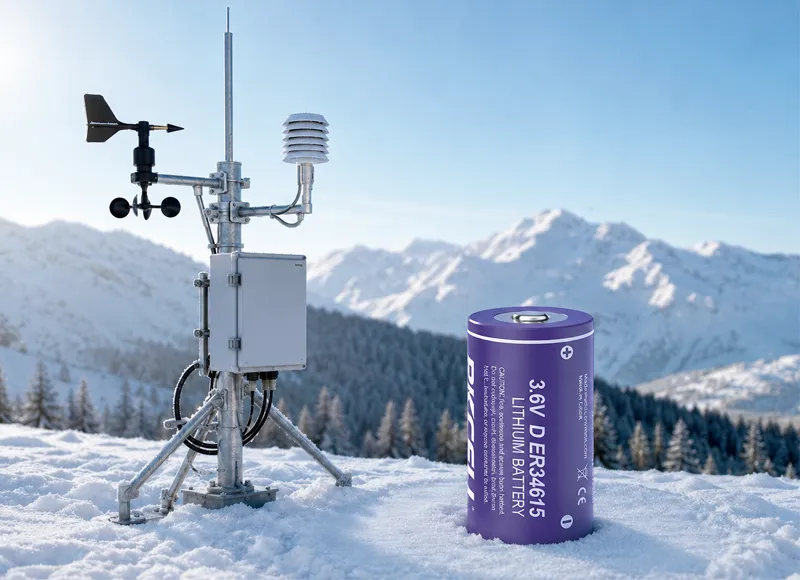
ER batteries can operate reliably from –55°C to +85°C, and some specialized models can go beyond this range. This makes them ideal for:
- Arctic climate monitoring
- Middle Eastern smart metering
- High-altitude weather stations
- Outdoor security systems
- Harsh industrial environments
Rechargeable lithium batteries simply cannot match this level of stability under extreme conditions.
1.4 High Reliability and Predictable Performance
ER batteries are known for:
- Very low leakage rates
- Stable voltage output
- Long-term chemical stability
- Predictable end-of-life behavior
For critical equipment—fire alarms, emergency transmitters, medical sensors—predictability is more important than capacity. ER batteries deliver both.
2. Market Forces Driving ER Battery Growth in 2024–2026
Technical advantages alone do not explain the recent surge in ER battery demand. The real driver is the global transformation toward digitalization, automation, and smart infrastructure.
2.1 The Global IoT Explosion
IoT devices have grown from 10 billion in 2020 to an expected 30 billion in 2026. A significant portion of these devices are:
- Wireless
- Low-power
- Remote
- Maintenance-free
This is exactly the type of environment ER batteries were designed for.
IoT applications include:
- Smart agriculture
- Smart cities
- Environmental monitoring
- Industrial automation
- Asset tracking
- Smart logistics
Each of these sectors requires long-lasting, reliable power sources. ER batteries are the default choice.
2.2 Smart Metering Upgrades Worldwide
Utilities across Europe, Asia, the Middle East, and South America are replacing mechanical meters with smart meters. These devices require:
- 10–15 years of battery life
- Stable performance in extreme temperatures
- Support for NB‑IoT, LoRa, or RF communication
- Zero maintenance
Li‑SOCl₂ ER batteries have become the global standard for smart water and gas meters. As countries continue to modernize their infrastructure, ER battery demand will remain strong.
2.3 Industrial Sensors and Industry 4.0
Industrial automation is accelerating worldwide. Factories, oil fields, chemical plants, and mining operations are deploying millions of sensors to monitor:
- Temperatura
- Pressure
- Flow
- Vibration
- Gas concentration
- Structural integrity
These sensors often operate in dangerous or inaccessible locations. ER batteries provide the long-term, stable power needed to support continuous monitoring without human intervention.
2.4 Growth in Security, Emergency, and Military Applications
Security and emergency systems require absolute reliability. ER batteries are used in:
- Smoke detectors
- Motion sensors
- Emergency transmitters
- Military radios
- Tactical equipment
- Battlefield sensors
In these applications, failure is not an option. ER batteries provide the stability and long-term performance required.
3. Why ER Batteries Cannot Be Replaced by Rechargeable Systems
With the rise of Li-ion and LiFePO₄, many wonder whether rechargeable batteries will eventually replace ER batteries. The answer is clear: not anytime soon.
3.1 Rechargeable Batteries Cannot Achieve 10–20 Years of Life
Even the best rechargeable batteries suffer from:
- Higher self-discharge
- Cycle degradation
- Temperature sensitivity
- Maintenance requirements
For remote or critical devices, charging is not feasible.
3.2 ER Batteries Offer Zero Maintenance
Rechargeable systems require:
- Charging infrastructure
- Regular maintenance
- Battery health monitoring
ER batteries require none of these. They simply work.
3.3 Extreme Temperature Performance Is Unmatched
Rechargeable lithium batteries degrade rapidly in cold or hot environments. ER batteries remain stable.
3.4 Cost Efficiency Over the Device Lifecycle
While rechargeable batteries may seem cheaper upfront, the total cost of ownership—including maintenance, replacement, and downtime—is far higher.
ER batteries win in long-term economics.
4. The Future Outlook: ER Batteries Will Stay Hot for Another Decade
The global shift toward automation, smart infrastructure, and IoT guarantees that ER batteries will remain in high demand. Key trends include:
- Continued smart meter deployments
- Rapid expansion of IoT in agriculture and logistics
- Growth of industrial automation
- Increased use of remote sensors in environmental protection
- Rising demand for military-grade power solutions
ER batteries are not outdated—they are perfectly aligned with the future of low-power, long-life, maintenance-free electronics.
Conclusión
ER batteries remain one of the hottest and fastest-growing battery technologies in 2026 because they deliver something modern rechargeable systems cannot: long-term, stable, maintenance-free power in extreme and critical environments. As IoT, smart metering, industrial automation, and security systems continue to expand globally, ER batteries will remain indispensable.
They are not a legacy technology. They are a future-proof technology.: