 Pile alcaline
 Batterie carbone-zinc
 Pile bouton
 Piles primaires au lithium
 Piles rechargeables
 Pack batterie personnalisé
 Batterie lithium rechargeable par USB
Introduction
The rapid evolution of modern healthcare has driven medical devices to become smaller, smarter, and more portable. From wearable insulin pumps and handheld defibrillators to complex surgical tools, the reliability of these devices depends heavily on their power source. Consequently, selecting the ideal LiPo for medical solution projects has become a critical focal point for medical device manufacturers worldwide.
Lithium Polymer (LiPo) batteries have emerged as the premier choice for medical applications. Unlike standard consumer electronics, medical-grade LiPo batteries must adhere to ultra-strict standards of safety, biocompatibility, and longevity. This article explores why LiPo batteries are uniquely suited for the medical sector, breaking down their distinct technical advantages and the advanced manufacturing processes that ensure their clinical-grade reliability.
Technical Advantages of Medical LiPo Batteries
When evaluating a LiPo for a medical solution, design engineers prioritize technical parameters that ensure uninterrupted device operation and patient safety.
1. Enhanced Safety Performance and Risk Mitigation
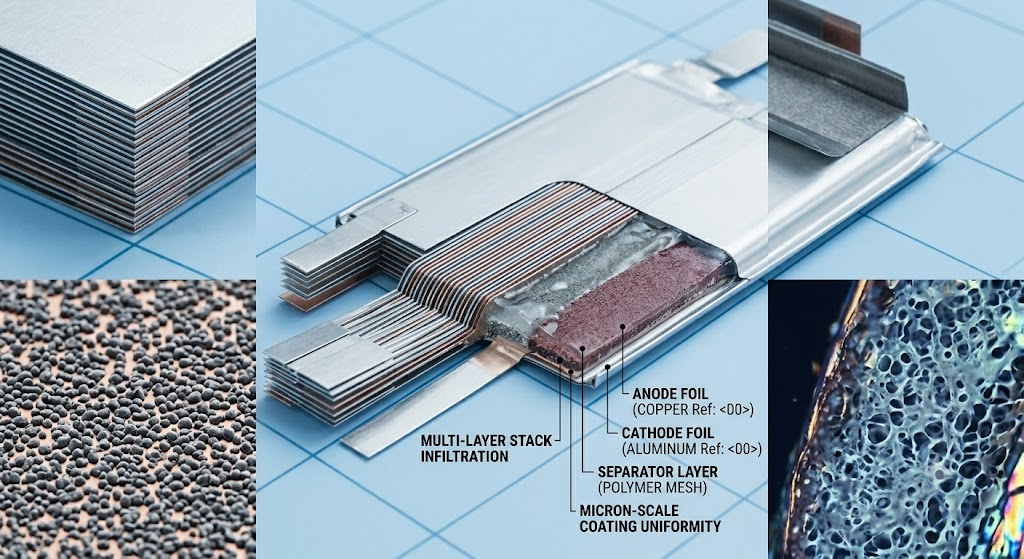
Safety is the absolute bottom line in healthcare. Standard lithium-ion batteries with rigid metallic casings risk explosion under severe internal short-circuits or thermal runaway. In contrast, medical LiPo batteries utilize a gel electrolyte and flexible aluminum laminated film packaging. If an anomaly occurs, the battery is designed to merely swell or vent gas rather than explode, drastically reducing risks to patients and medical staff.
2. High Energy Density and Lightweight Design
Modern medical technology demands longer runtimes without adding bulk to portable or wearable equipment. LiPo chemistry delivers exceptional energy density, enabling batteries to be incredibly thin (often $\le 1\text{ mm}$) and lightweight. This directly improves the ergonomics of handheld diagnostic tools and the comfort of wearable patient monitors.
3. Unparalleled Form Factor Flexibility (Customization)
Medical device enclosures frequently feature complex, irregular internal geometries to fit PCBs, sensors, and mechanical parts. Standard cylindrical cells (like 18650s) create wasted space. Medical LiPo cells can be customized into various shapes—curved, ultra-thin, round, or trapezoidal—maximizing the utilization of available space within the device.
Precision Manufacturing Process of Medical LiPo Cells
Achieving medical-grade certification (such as ISO 13485, IEC 60601-1, and UL 2054) requires an ultra-precise, contamination-free manufacturing process. The production line of a premium LiPo for a medical solution involves several critical phases:
1. High-Precision Electrode Slurry Mixing and Coating
The process begins with the preparation of cathode (e.g., LiCoO₂ or NMC) and anode (graphite) slurries. For medical applications, the uniformity of the slurry is controlled to microscopic levels. Automated slot-die coating machines apply the slurry onto aluminum and copper foils with sub-micron thickness tolerances, preventing any hot spots or uneven aging during subsequent cycles.
2. Advanced Stacking (Z-Fold) Process
Unlike standard consumer batteries that use a cylindrical winding (jelly-roll) mechanism, medical-grade LiPo cells predominantly utilize an advanced Z-fold stacking process.
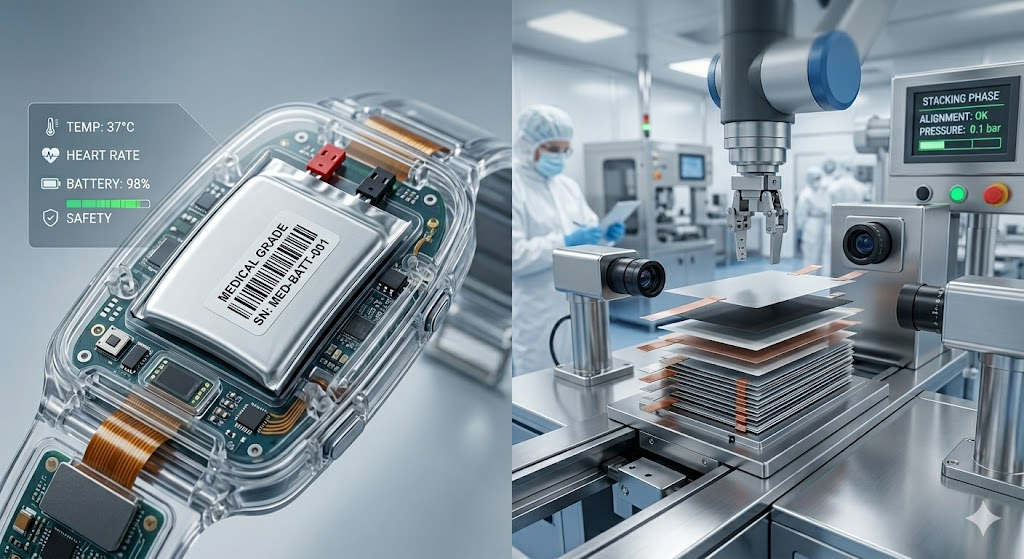
- Precision Alignment: Positive electrodes, separators, and negative electrodes are stacked neatly layer by layer.
- Avantages : Stacking provides superior internal current distribution, lower internal resistance ($IR$), and better thermal dissipation. This ensures the battery remains cool during rapid high-current discharges, which is crucial for devices like surgical staplers or portable defibrillators.
3. Vacuum Sealing & Electrolyte Injection
The stacked core is placed into a deep-drawn aluminum laminated pouch. After precise, automated injection of a highly stable gel electrolyte, the pouch undergoes vacuum sealing. This step eliminates any micro-bubbles or moisture inclusions that could lead to internal gassing or premature capacity degradation over time.
4. Rigorous Formation, Aging, and Traceability
Before a medical LiPo battery leaves the factory, it undergoes an intensive “formation and aging” protocol. Cells are stored in temperature-controlled chambers for weeks while their voltage, capacity, and self-discharge rates are continuously logged. Full barcode traceability ensures that every individual cell can be tracked back to its raw material batches, fulfilling rigorous medical auditing mandates.
Conclusion
Choosing the right LiPo for a medical solution is not just about choosing a battery; it is about guaranteeing patient safety and device efficacy. Technologically, LiPo chemistry offers the lightweight efficiency, shape flexibility, and inherent safety that modern medical hardware requires. On the production floor, it is the combination of advanced Z-fold stacking, precise pouch encapsulation, and uncompromising quality control that elevates consumer-grade tech into a dependable medical component.
As healthcare continues to shift toward remote patient monitoring and minimally invasive surgeries, custom medical LiPo batteries will remain the heartbeat of medical innovation. Partnering with a certified, experienced medical battery manufacturer ensures your device complies with stringent global healthcare standards while delivering flawless performance when it matters most.
FAQ
What makes a LiPo battery “medical-grade” compared to a standard LiPo?
Medical-grade LiPo batteries are distinct in their regulatory certifications, safety redundancy, and batch consistency. Unlike consumer batteries, they must pass strict tests such as IEC 60601-1, UL 2054, and UN38.3. Furthermore, factories must adhere to ISO 13485 quality systems to guarantee full material traceability.
Why is the Z-fold stacking process preferred over the winding process?
The Z-fold stacking process ensures uniform internal current distribution and superior heat dissipation. Winding processes can cause stress concentrations at corners, leading to localized heating. For critical medical applications, the mechanical stability of stacked cells is far safer.
How do medical LiPo batteries handle thermal runaway and swelling risks?
Medical LiPo cells utilize a flexible aluminum laminated pouch and a gel-state polymer electrolyte. If an anomaly occurs, the battery swells gradually rather than exploding. They are also integrated with a Smart BMS for multi-tier voltage and thermal protection.
Can LiPo batteries be customized to fit irregular enclosures?
Yes, absolute design flexibility is one of the greatest advantages. Medical device manufacturers can customize the length, width, thickness, and shape (such as curved or stepped profiles) to perfectly fit compact and ergonomic devices.