 Pile alcaline
 Batterie carbone-zinc
 Pile bouton
 Piles primaires au lithium
 Piles rechargeables
 Pack batterie personnalisé
 Batterie lithium rechargeable par USB
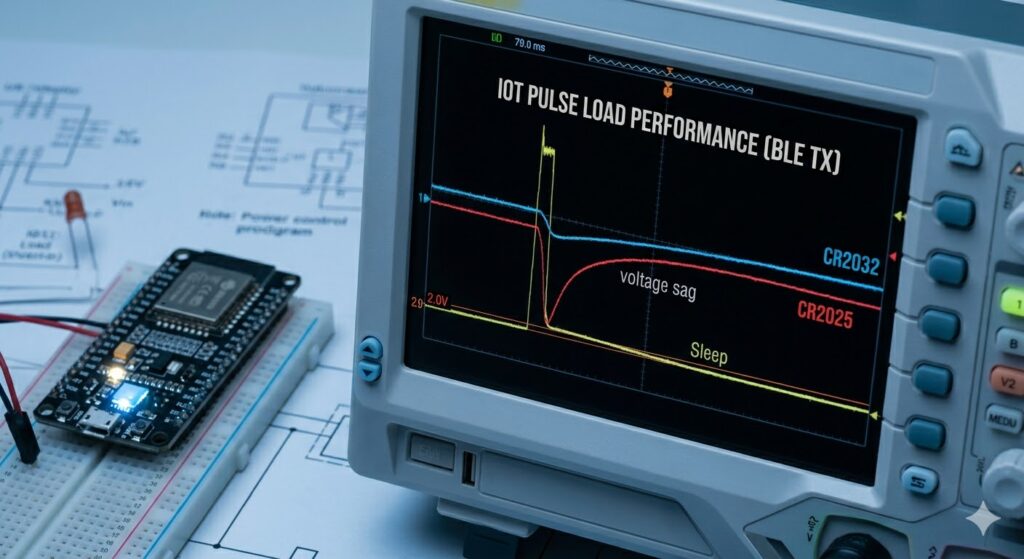
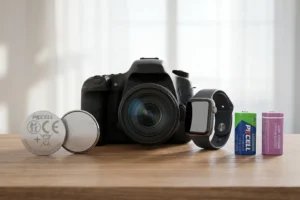
Coin cell batteries are widely used in modern electronic devices due to their compact size, stable voltage output, and long shelf life. Among the many models available, CR2032 et CR2025 are two of the most commonly used lithium coin cell batteries in consumer electronics and IoT products.
From Bluetooth trackers and smart home sensors to wearable medical devices, these small batteries power millions of devices worldwide.
Although the CR2032 and CR2025 look very similar, their performance characteristics are quite different. Factors such as battery capacity, internal resistance, pulse current capability, and mechanical design constraints can significantly impact the reliability and lifespan of an IoT device.
In this article, we will explore the differences between CR2032 vs CR2025 batteries, explain their internal structure, and help engineers determine which battery is the better choice for their applications.
This stage usually lasts only a few milliseconds.
Wireless Data Transmission
The most power-intensive stage occurs during wireless communication.
Wireless modules such as:
- Bluetooth Low Energy (BLE)
- Zigbee
- LoRa
- Sub-GHz RF
can generate current spikes of 10–30 mA or more during transmission.
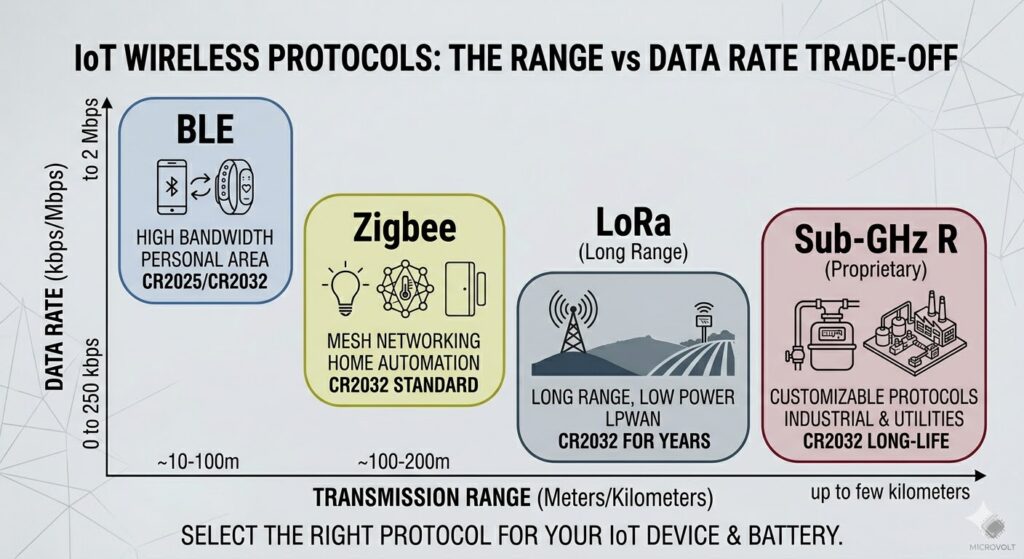
Although these spikes last only milliseconds, they can cause voltage drops in coin cell batteries, especially when internal resistance is high.
Internal Resistance and Voltage Sag in Coin Cell Batteries
Internal resistance plays a crucial role in the performance of lithium coin cell batteries.
When the current increases suddenly, the voltage drops according to the following relationship:
Voltage Drop = Current × Internal Resistance
Because the CR2032 contains more electrode material, it typically has lower internal resistance than the CR2025.
This difference becomes important when powering wireless IoT devices.
For example:
| Parameter | CR2032 | CR2025 |
|---|---|---|
| Résistance interne | Plus bas | Plus élevé |
| Pulse Current Capability | Better | More Limited |
| Voltage Stability | Stronger | More Sag Under Load |
If an IoT device draws 20 mA during transmission, a CR2025 battery with higher internal resistance may experience a temporary voltage sag.
If the voltage momentarily falls below the MCU’s brown-out threshold, the device may reset or reboot, even though the battery still contains usable energy.
This is one of the most common reasons IoT devices fail in real-world deployments.
For this reason, engineers often choose CR2032 batteries for wireless IoT applications.
Mechanical Integration and PCB Design Considerations
Battery selection also affects the mechanical design of the product.
The chosen coin cell battery influences:
- Battery holder selection
- PCB layout
- Device thickness
- Manufacturing process
Battery Holders and Contact Reliability
CR2032 battery holders are extremely common and widely available.
However, inserting a CR2025 battery into a CR2032 holder is not recommended.
Because the CR2025 is thinner, the contact pressure between the battery and the holder may be insufficient.
This can lead to problems such as:
- Intermittent power loss
- Poor electrical contact
- Fretting corrosion
- Device resets during vibration
For products exposed to movement—such as asset trackers, industrial sensors, or smart locks—reliable contact pressure is essential.
SMD vs Through-Hole Battery Holders
Coin cell holders are typically available in two mounting styles.
Through-Hole Holders
Avantages :
- Strong mechanical attachment
- Better vibration resistance
Disadvantages:
- Slower assembly
- Less suitable for thin devices
Surface-Mount (SMD) Holders
Avantages :
- Compatible with automated SMT assembly
- Lower manufacturing cost
Disadvantages:
- Slightly weaker mechanical strength
Ultra-Thin Device Design
In some products, device thickness becomes the most important design constraint.
Examples include:
- Slim remote controls
- Medical wearable patches
- Smart cards
- Ultra-thin IoT sensors
In these situations, designers may choose CR2025 batteries because they allow the device to remain below 4 mm total thickness.
Some wearable electronics even use coin cell strap mounting designs, which minimize vertical space.
Shelf Life and Storage Performance
Lithium manganese dioxide batteries are known for their excellent shelf life.
Typical storage characteristics include:
- Up to 10 years shelf life
- Less than 1% self-discharge per year
However, IoT devices are often manufactured months before being deployed.
A typical supply chain may involve:
- Manufacturing
- Warehouse storage
- International shipping
- Customer installation
This process can take 6–12 months before the device is activated.
Environmental factors such as temperature and humidity may accelerate battery aging during storage.
Because the CR2032 has higher initial capacity, it provides a valuable energy buffer against capacity loss during storage.
For large-scale IoT deployments, this additional margin can significantly improve field reliability.
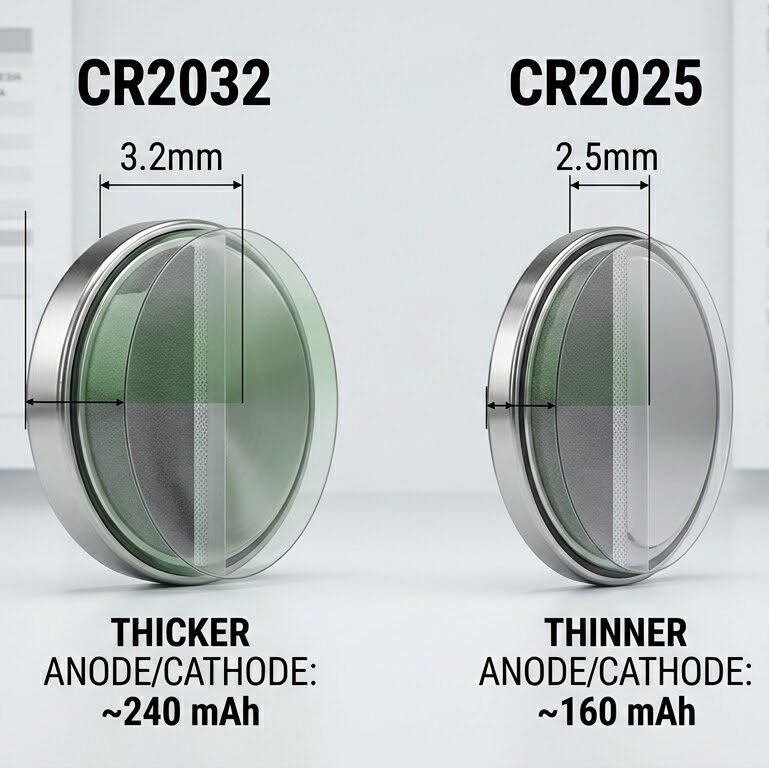
CR2032 vs CR2025 Comparison Table
| Fonctionnalité | CR2032 | CR2025 |
|---|---|---|
| Diamètre | 20 mm | 20 mm |
| Épaisseur | 3,2 mm | 2,5 mm |
| Capacité | 220–240 mAh | 150–170 mAh |
| Résistance interne | Plus bas | Plus élevé |
| Pulse Current Handling | Better | Modéré |
| Durée de conservation | Jusqu'à 10 ans | Jusqu'à 10 ans |
| Applications courantes | Bluetooth trackers, IoT sensors, PC BIOS | Slim remotes, medical patches |
| Rapport coût-efficacité | Better (/mAh) | Design-driven |
Which Coin Cell Battery Should You Choose?
For most IoT device designs, CR2032 batteries are the recommended choice.
In approximately 90% of IoT applications, the additional 0.7 mm thickness is insignificant compared to the benefits:
- Longer battery life
- Better pulse current performance
- Lower internal resistance
- Improved reliability during wireless transmission
However, CR2025 batteries remain useful in applications where device thickness must be minimized.
If the industrial design requires an ultra-thin form factor, CR2025 may be the only viable option.
In these cases, engineers must carefully optimize:
- firmware power management
- wireless transmission intervals
- sensor duty cycles
to ensure the reduced battery capacity still meets product lifetime requirements.
Conclusion
Both CR2032 and CR2025 batteries play an important role in modern electronic devices, particularly in IoT and wearable technology.
While they share the same diameter and voltage, their capacity, internal resistance, and pulse current capabilities differ significantly.
For most wireless IoT applications, the CR2032 battery provides superior performance and longer device lifespan.
However, the CR2025 battery enables ultra-thin product designs, making it suitable for space-constrained devices.
By carefully evaluating the power consumption profile, mechanical constraints, and product lifecycle, engineers can choose the coin cell battery that delivers the best balance of performance, size, and reliability.