 알카라인 배터리
 탄소 아연 배터리
 버튼 셀 배터리
 기본 리튬 배터리
 충전식 배터리
 맞춤형 배터리 팩
 USB 충전식 리튬 배터리
The global healthcare landscape is shifting toward decentralized monitoring. Disposable Medical Sensors—ranging from Continuous Glucose Monitors (CGM) to smart cardiac patches—demand a power source that is as reliable as it is compact. At the heart of this revolution lies 리튬 염화 티오닐 클로라이드(Li-SOCl₂) battery technology.
1. Why Li-SOCl₂ is the Gold Standard for Medical Sensing
In the realm of primary (non-rechargeable) lithium batteries, the Li-SOCl₂ chemistry stands out for its unique performance profile, perfectly aligned with clinical needs:
- Exceptional Energy Density: Boasting up to 650 Wh/kg, these batteries allow sensors to maintain a “band-aid” thin profile without sacrificing operational life.
- Decade-Long Shelf Life: With a self-discharge rate of less than 1% per year, sensors powered by Li-SOCl₂ can remain in hospital inventory for years and perform instantly upon activation.
- Stable Voltage Plateau: Unlike alkaline cells that drop voltage gradually, Li-SOCl₂ maintains a flat discharge curve (typically at 3.6V), ensuring the high-precision Analog-to-Digital Converters (ADCs) in sensors remain accurate until the very last drop of energy.
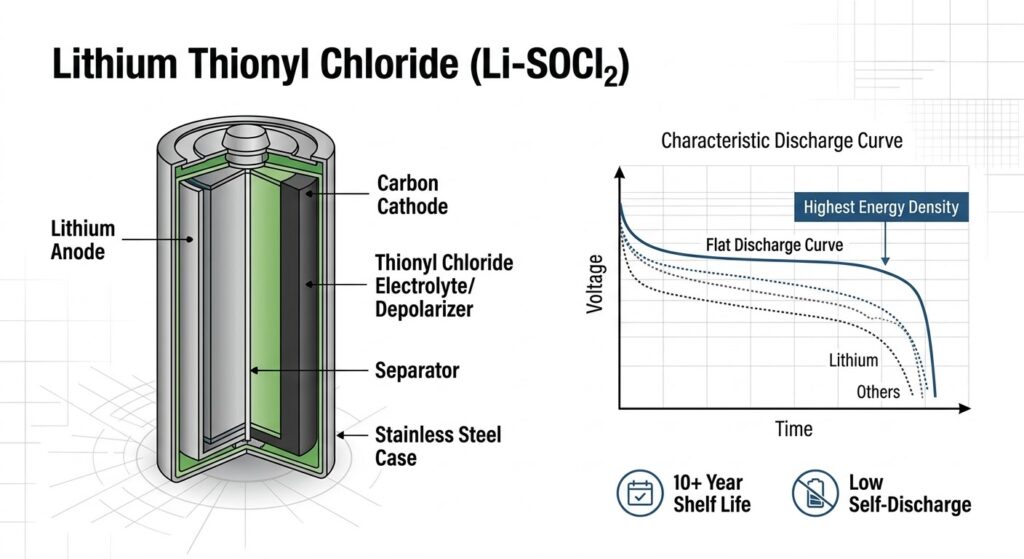
This image details the internal architecture of a Lithium Thionyl Chloride (Li-SOCl₂) cylindrical cell, highlighting the lithium anode, carbon cathode, and the SOCL₂ electrolyte/depolarizer. It visually maps the key advantages: Highest Energy Density, 10+ Year Shelf Life, and Flat Discharge Curve
2. Comparing the Energy Landscape in MedTech
While Li-SOCl₂ leads for long-term patches, other battery chemistries fill vital niches in the medical ecosystem:
| 배터리 유형 | Key Advantage | Typical Medical Application |
| Li-SOCl₂ (Primary) | Highest energy density & longevity | Long-term wearable patches (CGM, ECG) |
| 리튬 이온(리튬 이온) | High power burst & rechargeable | Digital endoscopes, powered surgical tools |
| USB Lithium | User convenience & standardization | Handheld diagnostic tools, nebulizers |
| Alkaline / Zinc-Carbon | Cost-effective & widely available | Digital thermometers, simple pen-lights |
3. Overcoming the “Pulse” Challenge
Medical sensors often spend 99% of their time in “sleep mode” (measuring data) and 1% in “active mode” (transmitting data via Bluetooth or NB-IoT). This requires a high pulse current that standard Li-SOCl₂ cells might struggle with due to passivation.
The Solution: Many high-end disposable sensors now utilize a Hybrid Layer Capacitor (HLC) in parallel with the Li-SOCl₂ battery. This “battery-capacitor” duo provides the steady energy for monitoring and the “instant kick” needed for wireless data transmission.
Industry Insight: Safety and Biocompatibility
In the medical field, performance isn’t the only metric—safety is paramount. Modern Li-SOCl₂ batteries for disposables are engineered with:
- Hermetic Sealing: Preventing leakage even under physical stress.
- Biocompatible Housing: Ensuring that even if a wearable patch is compressed, the chemistry remains isolated from the patient’s skin.
Expert Take: As we move toward “Smart Disposables,” the integration of thin-film Li-SOCl₂ will be the catalyst for the next generation of 7-day and 14-day continuous monitoring systems.
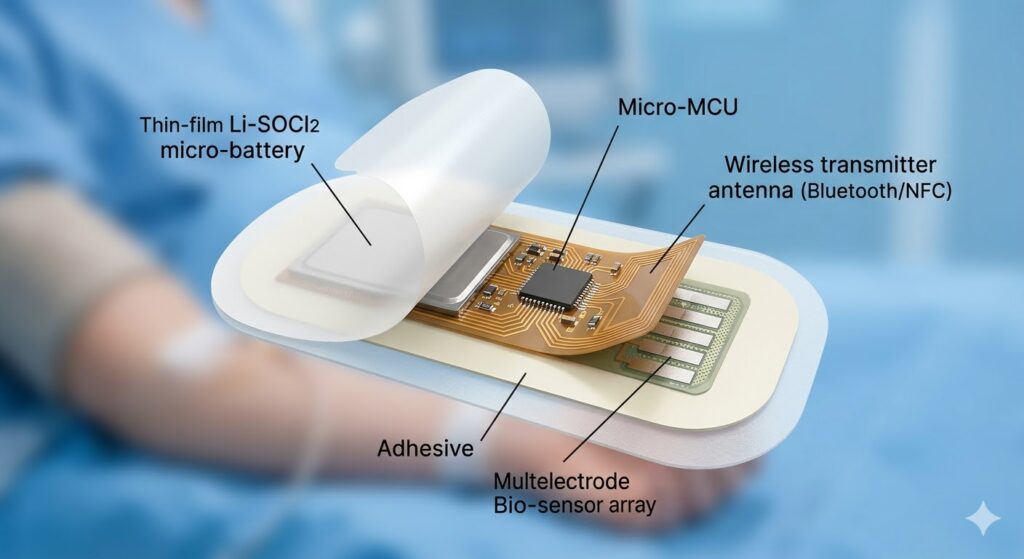
This image zooms in on a wearable, disposable smart medical patch. By peeling back the flexible layers, it reveals the integrated system: the bio-sensor array, a flexible PCB, a micro-wireless transmitter (Antenna/MCU), and the ultra-thin Li-SOCl₂ micro-battery that powers the entire 7-day monitoring system.
Smart Medical Sensor Patch Internal Components