
 Alkalibatterie
 Kohlenstoff-Zink-Batterie
 Knopfzellenbatterie
 Primäre Lithium-Batterien
 Wiederaufladbare Batterien
 Benutzerdefiniertes Akkupack
 Wiederaufladbare USB-Lithium-Batterie
Inhaltsübersicht
With the explosive growth of smart devices, power tools, and energy storage systems, cylindrical lithium-ion batteries like 18650s and 21700s have become the backbone of modern technology. However, when sourcing batteries or designing a new product, encountering prefixes like ICR, INR, and IFR can leave many purchasers and engineers confused.
These letters represent completely different chemical blueprints of the battery cells. Choosing the wrong battery type can lead to poor runtime, device incompatibility, or severe safety hazards like overheating.
In this comprehensive guide, we will break down the core differences between ICR, INR, and IFR lithium batteries to help you select the perfect cell for your specific application.
The Naming Decoded: Who in the Lithium Family?
Before diving into performance metrics, let’s understand the battery naming convention. The standard letter system for cylindrical lithium cells typically stands for: I (Lithium-ion) + Chemistry Letter + R (Round/Cylindrical).
- ICR Batteries (Lithium Cobalt Oxide LiCoO): The “C” stands for Cobalt. This is the most traditional lithium-ion technology, once standard in early laptops and digital cameras.
- INR Batteries (Lithium Nickel Manganese Cobalt Oxide – NMC): The “N” stands for Nickel. By blending nickel, manganese, and cobalt, INR represents the versatile “all-rounder” powering modern tech.
- IFR Batteries (Lithium Iron Phosphate -LiFePO): The “F” stands for Ferrum (Iron). Widely known as LFP, these batteries are world-famous for their ultimate safety and ultra-long lifespans.
Head-to-Head Comparison: Four Golden Performance Metrics
To make your sourcing decision easier, let’s compare ICR, INR, and IFR across four critical engineering dimensions: energy density, discharge capability, safety, and cycle life.
1. Energy Density (Capacity & Runtime)
- ICR > INR > IFR
- The Breakdown: ICR (LiCoO2) boasts excellent energy density, packing more capacity into a small footprint for longer single-charge runtimes. INR (NMC) follows closely behind. IFR (LFP) has a lower nominal voltage (3.2V), giving it a lower volumetric energy density and a larger physical footprint for the equivalent capacity.
2. Discharge Capability (Max Continuous Current)
- INR > IFR > ICR
- The Breakdown: INR cells have low internal resistance, allowing for massive high-drain/high-rate current outputs without massive voltage drops. IFR delivers a very stable and consistent current. ICR cells perform poorly under high-drain loads, heating up quickly if pushed too hard.
3. Thermal Stability and Safety
- IFR > INR > ICR
- The Breakdown: IFR is the ultimate champion of safety. Its thermal runaway threshold sits above 600°C, making it highly resistant to catching fire under extreme conditions like punctures or short circuits. INR introduces manganese to stay significantly safer than ICR, though it still requires a robust Battery Management System (BMS). ICR has the lowest thermal stability and requires precise protection logic.
4. Cycle Life (Lifespan Years)
- IFR (2,000+ Cycles) > INR (500 – 1,000 Cycles) > ICR (300 – 500 Cycles)
- The Breakdown: If your equipment needs to run for 5 to 10 years without a battery replacement, IFR is your only choice. Its cycle life is several times that of traditional ICR, leading to much lower long-term operating costs.
Technical Specifications Comparison Table
| Akku-Typ | Material der Kathode | Nennspannung | Core Advantages | Main Disadvantages |
| ICR | Lithium Cobalt Oxide ($LiCoO_2$) | 3.7V | Highest energy density, high capacity | Lower thermal stability, weak high-drain, shorter cycle life |
| INR | Nickel Manganese Cobalt (NMC) | 3.6V / 3.7V | Balanced performance, high discharge rate, and safe | Higher material costs |
| IFR | Lithium Iron Phosphate ($LiFePO_4$) | 3.2V | Ultimate safety, long cycle life, high temperature resistance | Lower energy density, lower nominal voltage |
Application Scenarios: Which Battery Fits Your Application?
In industrial and consumer hardware design, there is no absolute “best” battery—only the right match for your application’s requirements.
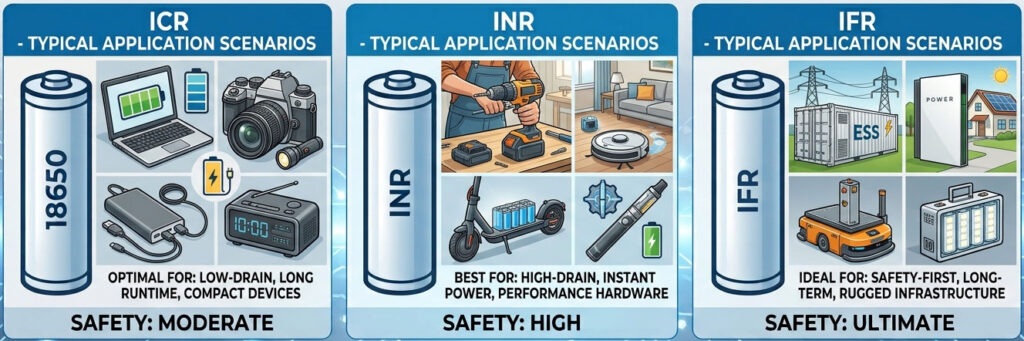
Choose ICR for: Low-Drain, Long Runtime, Compact Consumer Electronics
Because ICR cells focus on capacity rather than current output, they thrive in low-to-medium-power consumer electronics where space is tight.
- Typical Applications: Legacy laptops, power banks, standard LED flashlights, small portable household appliances, and digital cameras.
Choose INR for: High-Drain, Power-Hungry, High-Performance Hardware
INR successfully solves the engineering tradeoff between high capacity and high current. If your equipment needs instant torque or high wattage, INR is the go-to chemistry.
- Typical Applications: Cordless power tools (drills, circular saws), smart handheld vacuum cleaners, electric scooters, e-bikes, and advanced vaporizers.
Choose IFR for: Safety-First, Long-Term, Rugged Industrial Infrastructure
For high-investment infrastructure or systems operating in harsh environments where safety and a 10-year lifespan are non-negotiable, IFR (LFP) dominates.
- Typical Applications: Solar/Wind energy storage systems (ESS), residential backup walls, industrial AGV/AMR robotics, telecommunication base stations, and emergency lighting.
Summary & Sourcing Strategy
To simplify your procurement process, remember this rule of thumb: Choose ICR for runtime, INR for raw power, and IFR for safety and long-term durability.
As battery technology progresses, traditional ICR is increasingly being replaced by more stable INR solutions in consumer devices, while IFR captures the green energy storage market. When developing a new product, always factor in continuous working current, operational temperatures, and target product lifespan.
Are you looking for a tailored battery pack design or direct wholesale quotes on premium Grade-A cells? Contact our technical team today to get a customized, high-performance power solution for your business!


 English
  Français
  Español de México
  Deutsch
  Polski
  Italiano
  Русский
  한국어
한국어  Português