
 Alkaline Battery
 Carbon Zinc Battery
 Button Cell Battery
 Primary Lithium Batteries
 Rechargeable Batteries
 Custom Battery Pack
 USB Rechargeable Lithium Battery
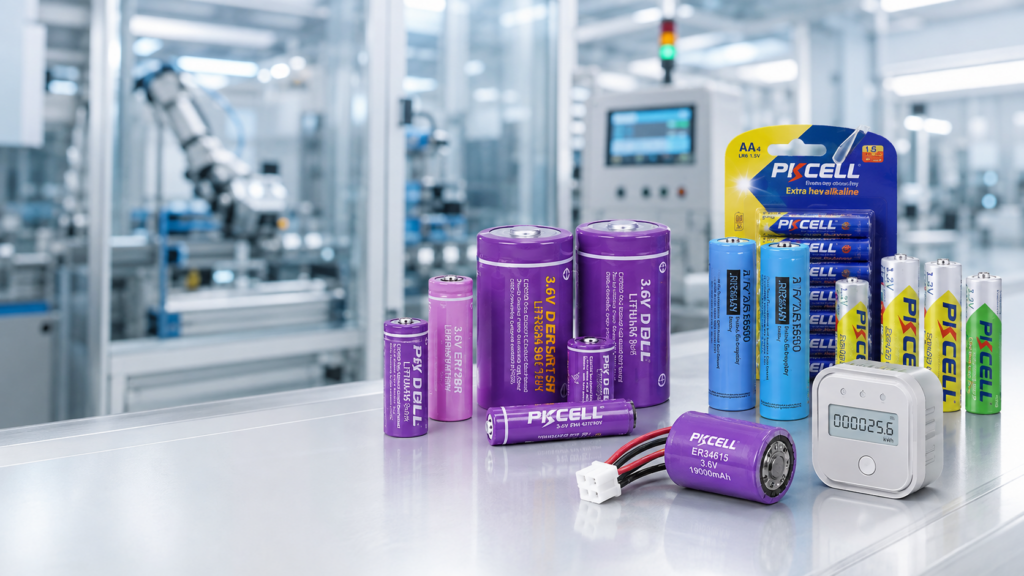
Finding a reliable China Li-SOCl2 battery supplier can be a complex task for B2B procurement managers, IoT hardware engineers, and supply chain directors. Lithium Thionyl Chloride (Li-SOCl2) batteries—commonly known as ER batteries—are critical power sources for applications requiring extra long operational lifespans and continuous reliability under extreme environmental conditions.
Whether you need high-capacity ER34615 cells for smart metering or HPC1520 hybrid capacitor configurations for high-pulse IoT communication, selecting a certified, high-quality manufacturer ensures system longevity, reduces maintenance overhead, and guarantees regulatory compliance.
This guide details the core technical metrics, customization options, certification standards, and decision criteria needed to partner with a leading custom Li-SOCl2 battery pack solution provider in China.
1. Understanding Li-SOCl2 Battery Chemistry and Key Advantages
Lithium Thionyl Chloride ($Li-SOCl_2$) chemistry offers the highest energy density among all primary (non-rechargeable) lithium battery commercial types. Understanding its core characteristics is essential for selecting the correct battery pack architecture.
-
Highest Energy Density: Delivers up to 650 Wh/kg and 1280 Wh/L, allowing maximum power storage in compact form factors.
-
High Nominal Voltage: Features a open-circuit voltage of 3.67V and an operating voltage ranging between 3.3V and 3.6V throughout most of its operational life.
-
Ultra-Low Self-Discharge: Features a self-discharge rate of less than 1% per year at room temperature (+20), enabling operating lifespans of 10 to 20 years.
-
Extreme Operating Temperature Range: Operates effectively from -55 to +85, with specialized high-temperature variants rated up to +150.
2. Bobbin Type vs. Spiral Type vs. Hybrid (ER + HPC) Configurations
When sourcing Li-SOCl2 battery packs, it is crucial to match cell construction to your device’s discharge profile. Leading Chinese OEM manufacturers offer three primary configurations:
| Battery Configuration | Internal Structure | Peak Current Capability | Best Suited Applications |
| Bobbin Type (e.g., ER34615) | High active material volume, low surface area | Low continuous/low pulse | Smart water/gas meters, AMR, environmental sensors |
| Spiral Type | Wound electrode structure, high surface area | High continuous pulse | Military equipment, oceanographic buoys, active tracking |
| Hybrid System (ER + HPC1520) | Bobbin Li-SOCl2 cell in parallel with Hybrid Pulse Capacitor | Very high pulse (up to several Amperes) | NB-IoT, LoRaWAN, satellite GPS asset trackers |
Why Choose the ER + HPC Hybrid Solution?
Standard bobbin-type Li-SOCl2 cells experience severe voltage passivation during idle periods. When an IoT device wakes up to send wireless transmissions (such as cellular NB-IoT or LoRaWAN bursts), this passivation layer can cause an initial voltage dip.
Integrating a Hybrid Pulse Capacitor (HPC1520) in parallel with a primary cell (like the ER34615 3.6V 19000mAh to 32000mAh) buffers peak pulse demands, eliminates voltage delay, and preserves total cell capacity over a 10+ year lifespan.
3. Top Applications for Certified Li-SOCl2 Batteries
Leading export-grade Li-SOCl2 suppliers produce custom battery solutions tailored to specific industrial ecosystems:
-
Smart Utilities & Metering: Automated Meter Reading (AMR) and Advanced Metering Infrastructure (AMI) for smart water, gas, electricity, and heat meters.
-
IoT & Asset Tracking: GPS tracking devices, cold-chain logistics monitoring, container tracking, and livestock monitoring.
-
Industrial Automation & Security: Wireless industrial sensors, smoke detectors, pipeline monitoring, toll tags, and electronic security systems.
-
Medical & Infrastructure: Backup power for memory modules, remote medical equipment, structural monitoring sensors, and offshore buoys.
4. Key Criteria for Selecting a Reliable China Li-SOCl2 Supplier
To identify a top-tier Chinese Li-SOCl2 battery supplier, evaluate potential manufacturing partners against four technical benchmarks:
1. Passivation Management Capabilities
Inquire about the manufacturer’s automated electrolyte processing and passivation control mechanisms. Top producers use ultra-pure electrolytes and precise additives to keep passivation predictable and manageable.
2. Comprehensive Global Certifications
High-quality lithium export manufacturers must comply with international transport, safety, and quality standards:
-
UL Standards: UL1642 safety certification for lithium cells.
-
Transport Approvals: UN38.3 test reports and MSDS documentation for air and sea freight.
-
Environmental Compliance: RoHS, REACH, and CE compliance for European and global markets.
-
Quality Management Systems: ISO9001 quality management and ISO14001 environmental management.
3. Advanced Custom OEM/ODM Capabilities
Industrial applications rarely use off-the-shelf cells without modification. A qualified custom battery pack factory should offer:
-
Custom wiring harnesses, JST/Molex connectors, and shrink-wrap options.
-
Spot-welded nickel tabs, PCB pin mountings, and custom plastic enclosures.
-
Diode/resistor integration for safety and back-feed protection.
-
Multi-cell series-parallel assembly ($3.6V$, $7.2V$, $10.8V$, or high-capacity parallel arrays).
4. Rigorous Quality Control and Testing Facilities
Verify that the factory utilizes automated testing procedures, including:
-
100% Open Circuit Voltage (OCV) and Closed Circuit Voltage (CCV) testing.
-
Micro-ampere leakage current analysis.
-
High-temperature aging and thermal shock testing.
-
Automated X-ray inspection for internal electrode alignment.
5. Step-by-Step Guide: How to Source Li-SOCl2 Batteries from China
To ensure a seamless procurement process and secure custom solutions tailored to your operational environment, follow this structured process:
-
Define Load Profiles: Record baseline sleep current, transmission pulse amplitude, pulse duration, cutoff voltage, and target operational lifetime.
-
Request Sample Testing: Request pre-production sample batches (including matching HPCs or custom wiring) for environmental chamber testing and load verification.
-
Verify Compliance Papers: Validate test reports directly with certifying bodies (such as UL database lookups) rather than relying solely on seller assertions.
-
Inspect Packaging & Transport Compliance: Confirm class 9 hazardous goods packaging capability (UN-certified boxes) for compliant international logistics.
Frequently Asked Questions
Key questions about choosing a reliable Li-SOCl₂ battery
manufacturer in China.
What is a Li-SOCl₂ battery?
A lithium thionyl chloride (Li-SOCl₂) battery is a primary,
non-rechargeable lithium battery known for its high energy
density, stable operating voltage, low self-discharge rate,
and wide operating temperature range. It is commonly used in
smart meters, IoT sensors, tracking devices, security systems,
and industrial equipment requiring long-term power.
How can I choose a reliable Li-SOCl₂ battery manufacturer in China?
Evaluate the manufacturer’s production experience,
quality-control procedures, technical support, customization
capabilities, production capacity, and international
certifications. A reliable supplier should provide traceable
test reports, application-specific recommendations, samples,
and consistent batch quality.
Which certifications should a Li-SOCl₂ battery supplier provide?
Depending on the target market and application, important
documents may include UL1642 certification, UN38.3 test
reports, MSDS documentation, RoHS and REACH compliance, and
CE-related documentation. ISO 9001 and ISO 14001
certifications can also demonstrate effective quality and
environmental management systems.
What is the difference between bobbin-type and spiral-type batteries?
Bobbin-type cells offer high capacity, very low self-discharge,
and long operating life, making them suitable for smart meters
and low-current sensors. Spiral-type cells support higher
continuous and pulse currents, making them better suited to
tracking, communication, and demanding industrial applications.
When should I use an ER battery with an HPC?
An ER battery combined with a Hybrid Pulse Capacitor is
recommended when a device has a low standby current but
periodically requires high-current pulses for NB-IoT, LoRaWAN,
GSM, GPS, or other wireless transmissions. The HPC supplies
the pulse current while the ER cell provides long-term energy.
How long can a Li-SOCl₂ battery last?
A properly selected Li-SOCl₂ battery may operate for 10 to
20 years under suitable conditions. Actual service life depends
on average current, pulse requirements, operating temperature,
cutoff voltage, self-discharge, passivation, and device design.
What information should I provide for a battery recommendation?
Provide the sleep current, operating current, maximum pulse
current, pulse duration, communication frequency, cutoff
voltage, expected service life, temperature range, available
installation space, connector requirements, and estimated
annual order quantity.
Can Li-SOCl₂ battery packs be customized?
Yes. Experienced OEM and ODM manufacturers can provide custom
wiring harnesses, connectors, solder tabs, PCB pins, protective
components, shrink wrapping, plastic enclosures, and series or
parallel battery configurations.
Why is passivation important in Li-SOCl₂ batteries?
Passivation is a protective layer that forms on the lithium
anode and helps reduce self-discharge during storage. However,
it may cause a temporary voltage delay after a long idle
period. Cell design, storage conditions, load profile, and
pulse-support components affect passivation performance.
How should battery samples be tested before mass production?
Test samples in the actual device or with an accurately
simulated load profile. Evaluate standby current, peak pulse
voltage, minimum operating voltage, voltage recovery,
passivation behavior, temperature performance, and projected
service life.
Are Li-SOCl₂ batteries rechargeable?
No. Standard Li-SOCl₂ batteries are primary batteries and must
not be recharged. Attempting to recharge them may cause
leakage, overheating, rupture, or other safety hazards. The
device circuit should prevent reverse current and accidental
charging.
What should I confirm before placing a bulk order?
Confirm the approved specifications, sample performance,
battery model, capacity, connector configuration, lead time,
quality standards, packaging, labeling, transportation
documents, warranty terms, and batch-traceability process.
都好一


 English
  Français
  Español de México
  Deutsch
  Polski
  Italiano
  Русский
  한국어
한국어  Português