
 Batteria alcalina
 Batteria al carbonio e zinco
 Batteria a bottone
 Batterie al litio primarie
 Batterie ricaricabili
 Pacchetto batteria personalizzato
 Batteria al litio ricaricabile USB
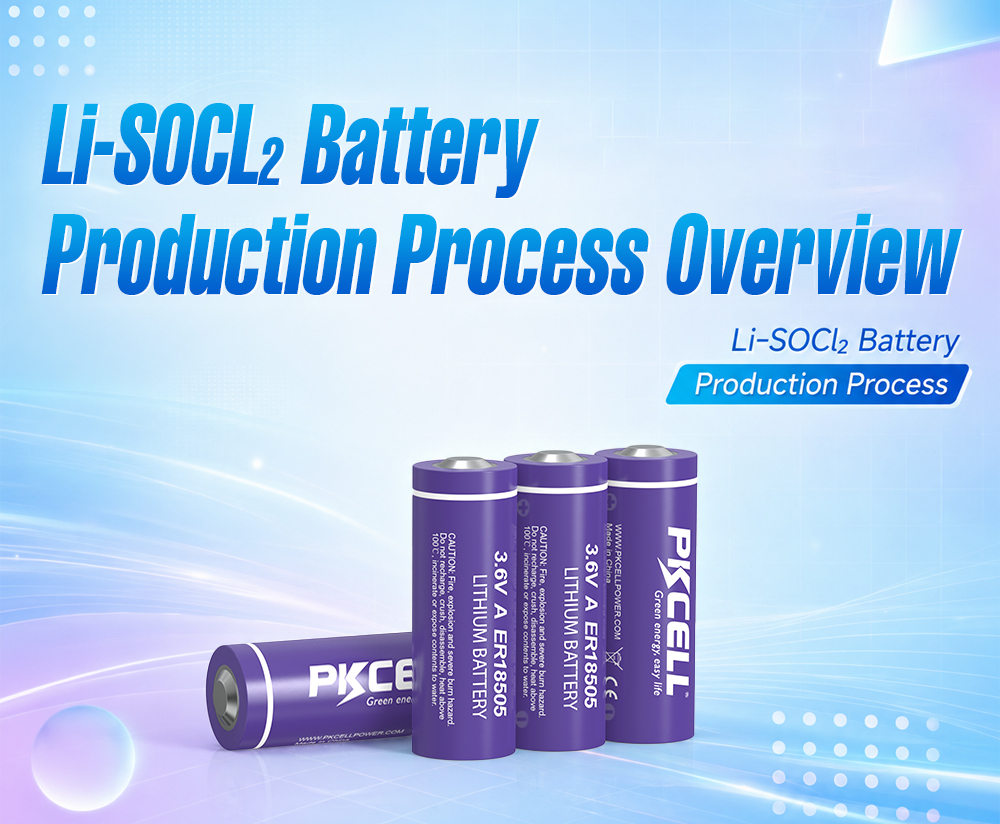
In the landscape of modern energy technology, Li-SOCl₂ batteries stand out for their ultra-high energy density, ultra-long shelf life, and outstanding low-temperature performance. As the core power supply for high-end fields including aerospace, deep-sea exploration, industrial smart meters, IoT sensing devices, and remote monitoring equipment, Li-SOCl₂ batteries are regarded as the reliable “heart power source” of high-precision electronic systems.
Although a cylindrical Li-SOCl₂ battery looks simple in appearance, its internal manufacturing process is extremely demanding. The whole production workflow requires strict dust-free and moisture-free workshop conditions, micron-level processing precision, and standardized chemical reaction control. Every production link is closely linked to battery safety, cycle stability, self-discharge rate, and long-term storage performance. Today, we take an in-depth look at the complete manufacturing process of Li-SOCl₂ batteries and uncover the professional technology behind high-energy primary lithium batteries.
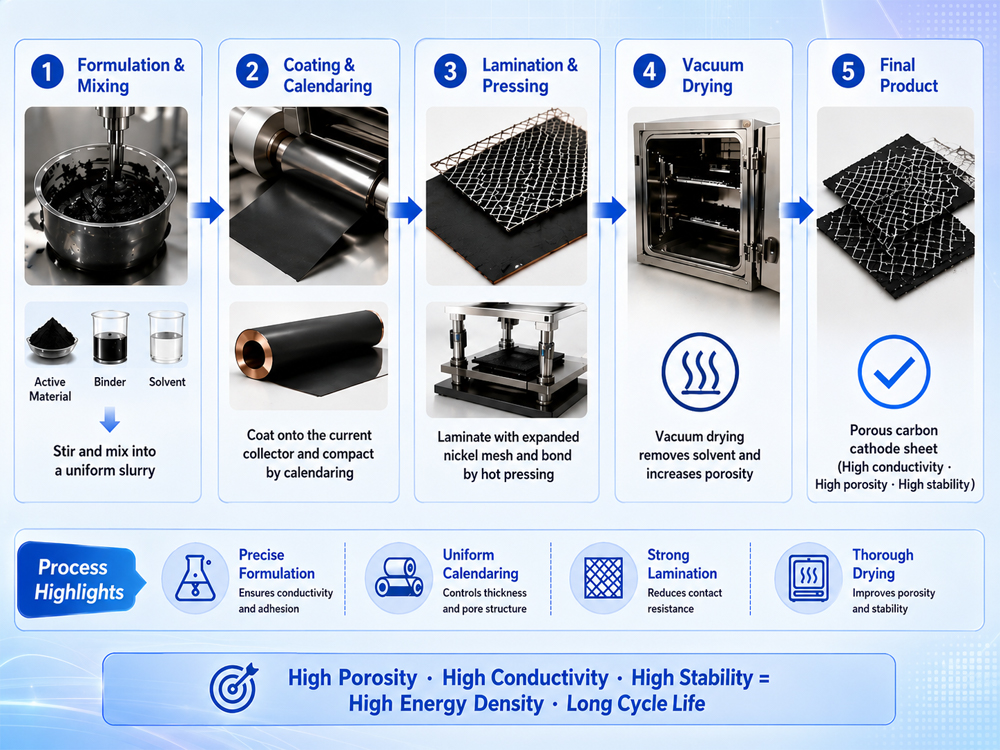
1. Positive Electrode Production: Precision Crafting of Porous Carbon Film
The positive electrode is not only the core reaction platform for electrochemical conversion but also acts as a storage reservoir for electrolyte, relying on its unique porous carbon structure. The production of positive electrodes determines the battery’s energy density, liquid absorption capacity, and overall reaction efficiency.
First comes material batching and mixing. Adhesive materials are fully blended with special solvents and stirred continuously to form a uniform viscous paste. The ratio of raw materials must be precisely controlled to avoid affecting conductivity and structural stability. Next is rolling and forming. The mixed paste is repeatedly rolled into carbon film with consistent thickness, then cut into standard sizes according to different battery models, such as ER18505 3.6V and 6V lithium batteries. For special specification batteries, the positive electrode will be pressed into custom shapes like carbon packages or hollow carbon rods to adapt to different internal structural designs.
After shaping, composite lamination and high-temperature drying are carried out. A conductive framework is attached to the porous carbon film as the current collector, and the two parts are tightly compounded by pressure equipment. Subsequently, the composite electrode is heated and dehydrated in a constant temperature oven to completely remove internal moisture. This dehydration process is critical, directly affecting the initial discharge efficiency, chemical stability, and long-term storage life of finished Li-SOCl₂ batteries.
2. Negative Electrode Preparation: Maximizing Utilization of Lithium Metal
Compared with the complex positive electrode process, the production of the lithium negative electrode seems straightforward but contains sophisticated structural design principles. A pure lithium strip is pressed tightly onto the conductive framework through mechanical compression molding technology. This integrated structural design optimizes the internal electron conduction path, reduces internal resistance effectively, and greatly improves the utilization rate of lithium metal materials. A well-made negative electrode can avoid local overreaction and ensure stable and consistent discharge output in long-term working scenarios.
3. Diaphragm Selection: Balancing Safety and Ion Conduction
The diaphragm is the safety barrier between the positive electrode and negative electrode of Li-SOCl₂ batteries. It undertakes two core missions: preventing direct contact of positive and negative materials to avoid internal short circuit, and maintaining unobstructed ion penetration during electrochemical reaction. Most Li-SOCl₂ batteries adopt a high-performance polypropylene diaphragm. Engineers accurately control the diaphragm thickness to strike a perfect balance between safety performance and internal resistance. Too thick a diaphragm will increase internal resistance and reduce discharge efficiency; too thin will bring hidden dangers of short circuit and thermal runaway. Reasonable diaphragm selection is an indispensable part of battery safety design.
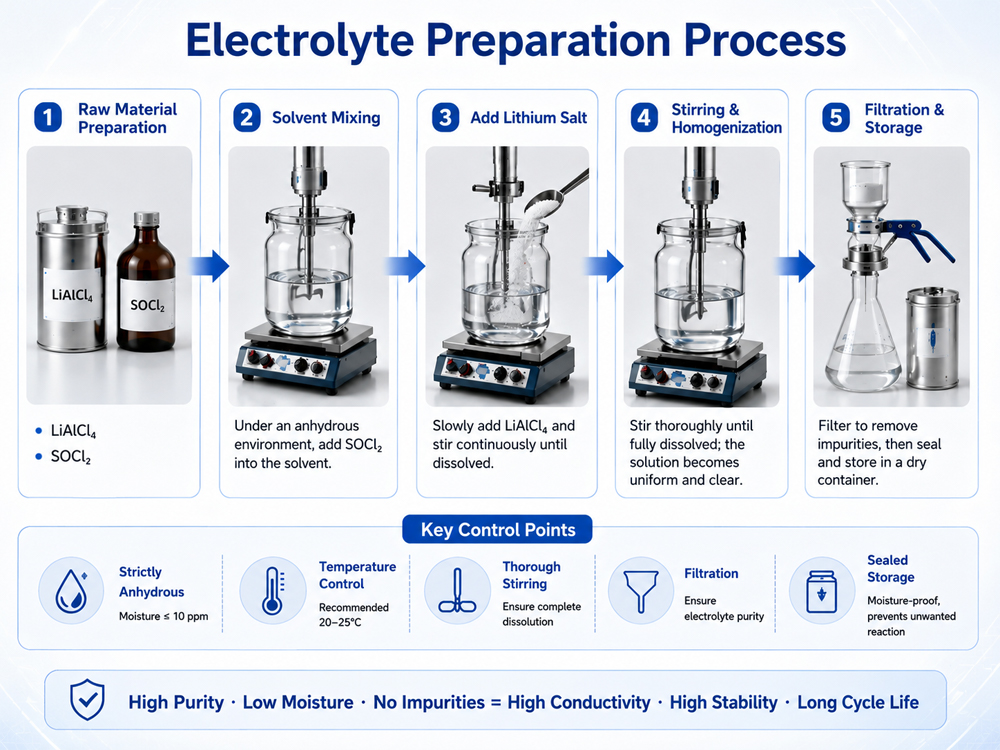
4. Electrolyte Formulation: Core Liquid Prepared in an Anhydrous Environment
Electrolyte is the core of Li-SOCl₂ batteries, carrying ion migration and supporting the whole electrochemical reaction. The entire electrolyte preparation must be completed in a strictly anhydrous and low-humidity dry room. Even trace moisture will trigger violent chemical reactions, cause battery swelling, leakage or performance degradation.
The first step is electrolyte salt preparation. Anhydrous lithium chloride and anhydrous aluminum chloride are mixed and ground evenly, then heated to a molten reaction state under a protective atmosphere. After natural cooling, the mixture is crushed into fine powder for standby. The second step is electrolyte configuration. In a dry environment with ultra-low humidity, the prepared electrolyte salt is slowly added into distilled and purified thionyl chloride solvent with continuous stirring until the standard concentration of electrolyte is formed. The final step is electrolyte purification. Industrial-grade lithium metal is used to remove trace impurities and residual moisture in the solution, which is the key process to guarantee ultra-low self-discharge rate and decade-level shelf life of Li-SOCl₂ batteries.
5. Cell Assembly: Micro-level Production in Clean Room
Cell assembly is equivalent to a precise microsurgery, requiring semiconductor-grade clean room standards with strict control of dust, humidity, and temperature. Firstly, cell winding or lamination is conducted. According to the sequence of negative electrode – diaphragm – positive electrode, the three materials are wound or stacked neatly into a complete cell, then placed into a sealed steel shell.
Then comes welding and packaging. Laser welding technology is used to firmly connect the cell current collector with the pole of the battery cover assembly to ensure smooth circuit conduction and excellent air tightness. After welding, vacuum liquid injection and final sealing are performed. Under high vacuum conditions, the configured electrolyte is accurately injected into the steel shell to fully infiltrate the internal cell structure. Finally, the battery is hermetically sealed to complete the main production process of a Li-SOCl₂ cell.
6. Reliability Verification Test: Strict Inspection for Qualified Products
Finished semi-finished batteries cannot be launched directly to the market. They must go through a series of brutal reliability tests to simulate various extreme working conditions. The test items include vibration test, mechanical impact test, external short circuit test, extrusion test, forced discharge test, abnormal charging test, and free drop test. Only products that pass all safety and performance tests can obtain qualification certification and be applied to industrial equipment, smart meters, and IoT terminal devices.
From raw material mixing of positive electrodes, high-temperature synthesis of electrolyte salts, to laser welding, sealing, and vacuum liquid injection, every procedure of Li-SOCl₂ batteries integrates material science, chemical engineering, and precision manufacturing technology. The pursuit of extreme craftsmanship enables Li-SOCl₂ batteries to maintain a stable energy supply in ultra-high and ultra-low temperature environments. PKCELL, as a professional lithium battery manufacturer, adheres to strict production standards and provides long-life, high-reliability Li-SOCl₂ power solutions for global smart instrumentation, IoT, and industrial intelligent equipment.
Domande frequenti



 English
  Français
  Español de México
  Deutsch
  Polski
  Italiano
  Русский
  한국어
한국어  Português