
 알카라인 배터리
 탄소 아연 배터리
 버튼 셀 배터리
 기본 리튬 배터리
 충전식 배터리
 맞춤형 배터리 팩
 USB 충전식 리튬 배터리
A compact electronic device may have enough internal space for a lithium polymer battery, but that does not necessarily mean a suitable battery is ready for production. The available installation space, connector arrangement, operating current and charging circuit can all influence the final battery configuration.
For product developers and purchasing teams, preparing a detailed request for quotation (RFQ) helps reduce unnecessary communication, identify suitable battery models and obtain quotations based on consistent project requirements.
What should a custom LiPo battery RFQ include?
A useful RFQ should specify the device application, maximum finished battery dimensions, voltage, required capacity, operating and peak current, charging conditions, connector configuration, protection requirements, sample quantity and expected production volume.
1. Define the Device Before Requesting a Battery Quote
A quotation request that only specifies “3.7V 500mAh LiPo battery” provides a starting point, but it does not establish whether the battery can meet the device’s installation and operating requirements.
Different compact products have different design priorities:
| 디바이스 유형 | Typical Design Priority | Information to Include in the RFQ |
|---|---|---|
| Wearable electronics | Limited thickness and weight | Maximum battery envelope and weight limit |
| Wireless sensors | Standby time and transmission loads | Sleep current and transmission current profile |
| Bluetooth accessories | Operating time and compact installation | Runtime target and charging requirements |
| Handheld instruments | Stable operation during active use | Continuous current and temporary peak loads |
| Portable personal care devices | Motor startup and housing integration | Startup current and installation drawings |
Providing the application at the beginning allows a battery supplier to assess whether an existing model or a customized assembly is a more practical option.
2. Custom LiPo Battery RFQ Checklist
The following checklist separates the information needed for an initial feasibility assessment from details that should be finalized before sample approval.
| RFQ Item | Required Information | Confirmation Stage |
|---|---|---|
| Device application | Product type and intended operating environment | Initial RFQ |
| Battery dimensions | Maximum thickness, width and length of the finished assembly | Initial RFQ |
| 전압 | Nominal voltage and device operating voltage range | Initial RFQ |
| 용량 | Minimum acceptable capacity and target runtime | Initial RFQ |
| Discharge current | Continuous current, peak current and peak duration | Initial RFQ |
| Charging conditions | Charging voltage, current and charging circuit requirements | Before sample approval |
| Wire assembly | Wire length, exit direction and insulation requirements | Before sample approval |
| Connector | Part number, pinout, polarity and mating connector | Before sample approval |
| Protection | PCM requirements and temperature sensing, if required | Before sample approval |
| Documentation | Applicable test reports, transport documents and market requirements | Before final quotation and approval |
| Order volume | Sample quantity, first production order and annual forecast | Initial RFQ |
| Project schedule | Sample deadline, production target and delivery destination | Initial RFQ |
If some specifications are still under development, identify them as preliminary or to be confirmed. This is more useful than providing estimated values as finalized requirements.
3. Specify the Finished Battery Envelope, Not Just the Cell Size
One of the most common sources of redesign in compact devices is the difference between bare pouch cell dimensions and the space required by a complete battery assembly.
A finished configuration may include a protection circuit module, insulating materials, wire connections and a connector. The required installation envelope can therefore differ from the nominal cell size.
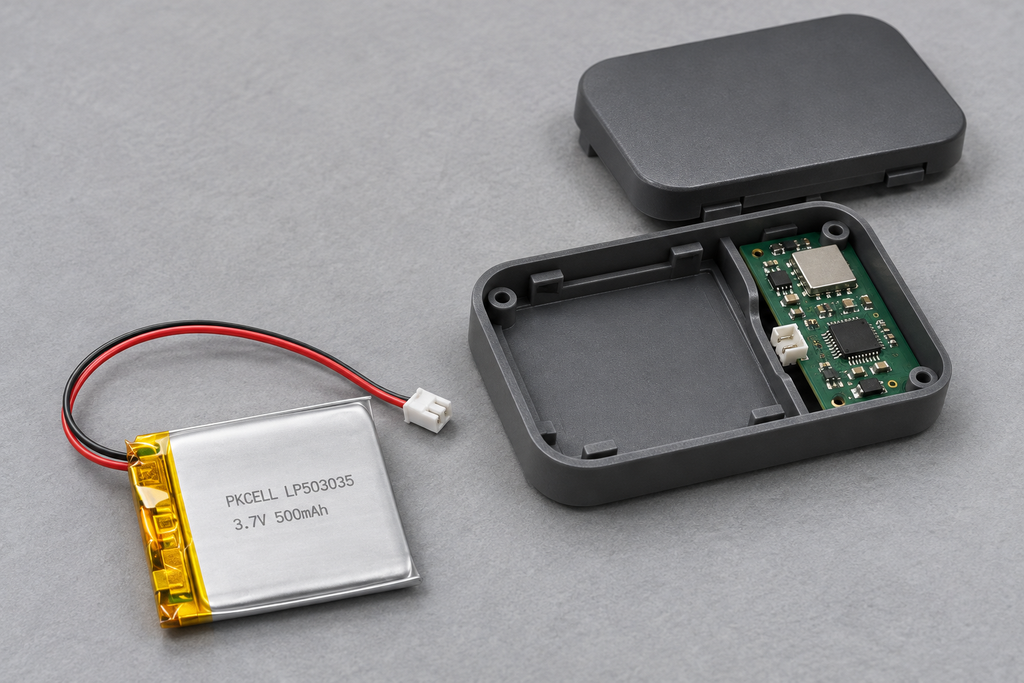
When preparing mechanical information, send a dimensioned drawing that shows the available battery space, wire routing direction, connector location and nearby structural components. The design must accommodate the manufacturer’s dimensional tolerances and required expansion clearance without compressing or damaging the pouch cell.
Existing models such as the LP401230 lithium polymer battery 그리고 LP503035 rechargeable pouch cell can provide initial references for projects with different space constraints.
Customers can also review the PKCELL lithium polymer battery range before requesting a completely new cell configuration. Final dimensions, capacity and assembly details should be confirmed against the current approved specification.
4. Confirm Connector and Protection Requirements Early
Two batteries with similar voltage, capacity and dimensions may still require different assembly configurations. For production customers, these differences can affect the quotation, installation process and compatibility with the device’s circuit board.
Instead of requesting a battery with a generic two-pin or three-pin connector, provide the connector part number, mating interface, pin assignment and required wire length. Connector appearance alone is not sufficient to establish electrical compatibility.
If temperature monitoring is required, specify the NTC characteristics and interface expected by the device. Protection circuit module (PCM) requirements should also be coordinated with the cell specification, charging circuit and expected load.
Confirming these details before sample production helps prevent unnecessary changes to the device housing, wiring harness or PCB connection.
5. Example RFQ for a Compact Wireless Sensor
The following example illustrates how a product development team can organize its requirements when contacting a lithium polymer battery manufacturer.
Project: Rechargeable Wireless Sensor
| Requirement | Example Specification |
|---|---|
| 배터리 유형 | Rechargeable lithium polymer |
| Nominal voltage | 3.7V |
| Target capacity | 500mAh |
| Available installation envelope | 6 × 32 × 40 mm |
| Continuous active current | 60mA |
| Peak current | 300mA for 200ms |
| Charging conditions | To be confirmed against the device charging circuit |
| Connector | 2-pin; part number and pinout drawing attached |
| Wire length | 50mm, subject to installation review |
| Protection | PCM required; specifications subject to engineering confirmation |
| Sample quantity | 10 units for evaluation |
| Estimated annual demand | 10,000 units |
| Supporting documents | Housing drawing, connector specification and measured load profile |
Note: This is an illustrative RFQ, not a verified customer project or an approved PKCELL battery specification. Final feasibility, charging limits, dimensions and commercial terms require engineering and supplier confirmation.
This format allows a supplier to identify unresolved requirements and assess whether an existing pouch cell with a customized assembly could satisfy the project, potentially avoiding the need to develop a new cell size.
6. How to Compare Custom LiPo Battery Quotations
The lowest quoted unit price does not necessarily represent the lowest total project cost. Before comparing quotations, confirm that each supplier is pricing the same battery configuration and commercial scope.
| Quotation Factor | What Buyers Should Confirm |
|---|---|
| Product configuration | Bare cell or complete assembly, including PCM, wires and connector |
| Development costs | Any engineering, tooling or one-time setup charges |
| Order requirements | Minimum order quantity and volume-based pricing |
| Sample costs | Sample price, development time and shipping charges |
| Documentation | Availability, applicability and cost of required reports |
| Production lead time | Lead time after specification approval and order confirmation |
| Delivery terms | Packaging, transport responsibilities and quoted trade terms |
For rechargeable lithium battery shipments, request the relevant UN 38.3 test summary and applicable transport information. Product safety documentation, such as IEC 62133-2 reports where applicable, should be checked against the actual battery model and finished configuration.
PKCELL’s OEM and ODM customization services cover requirement assessment, feasibility review, sample development and subsequent production.
7. What Should Be Approved Before Mass Production?
Receiving a working battery sample is an important milestone, but it should not be the only requirement for releasing a production order.
Both the customer and supplier should agree on a controlled battery specification that defines the approved construction and acceptance criteria.
- Approved battery drawing and finished dimensions.
- Confirmed electrical specifications and operating limits.
- Verified connector pinout, polarity and wire configuration.
- Approved sample revision and corresponding bill of materials.
- Agreed inspection and functional acceptance requirements.
- Procedures for communicating material or design changes.
For production consistency, sample evaluation should be connected to the supplier’s manufacturing and inspection procedures. Learn more about PKCELL’s battery quality control process when evaluating a long-term supply arrangement.
Request a Custom LiPo Battery Quote from PKCELL
Developing a compact electronic device or looking for an alternative lithium polymer battery supplier?
Send PKCELL your battery requirements, device drawings and estimated order volume. Our team can review existing cell options, discuss customized assembly requirements and assess the feasibility of your project.
Request a Custom Battery Quote
자주 묻는 질문
Can I request a LiPo battery quotation without a complete design?
Yes. An initial feasibility discussion can begin with the device application, available space, target voltage, capacity and estimated order volume. Unconfirmed specifications should be identified before requesting a final quotation.
Does a custom LiPo battery always require a new cell size?
No. Some projects can use an existing pouch cell with a customized wire harness, connector or protection circuit. This depends on mechanical fit, electrical compatibility and supplier feasibility.
What is the MOQ for a custom lithium polymer battery?
The minimum order quantity depends on cell availability, assembly requirements, customization complexity and production arrangements. Buyers should request a project-specific MOQ together with sample and production pricing.
Should I send an existing battery sample to the manufacturer?
An existing sample can help identify the physical configuration, but it should be supported by the device requirements, battery specification and connector information. A sample alone may not establish all electrical or safety requirements.
결론
A well-prepared custom LiPo battery RFQ is more than a request for price. It establishes a common technical and commercial reference for product developers, purchasing teams and battery manufacturers.
By separating initial feasibility requirements from final sample approval criteria, customers can make better sourcing decisions and reduce avoidable design revisions before production.


 English
 Français
 Español
 Deutsch
 Polski
 Italiano
 Русский
 한국어
 Português
 Nederlands (Formeel)