
 Alkaline Battery
 Carbon Zinc Battery
 Button Cell Battery
 Primary Lithium Batteries
 Rechargeable Batteries
 Custom Battery Pack
 USB Rechargeable Lithium Battery
Introduction
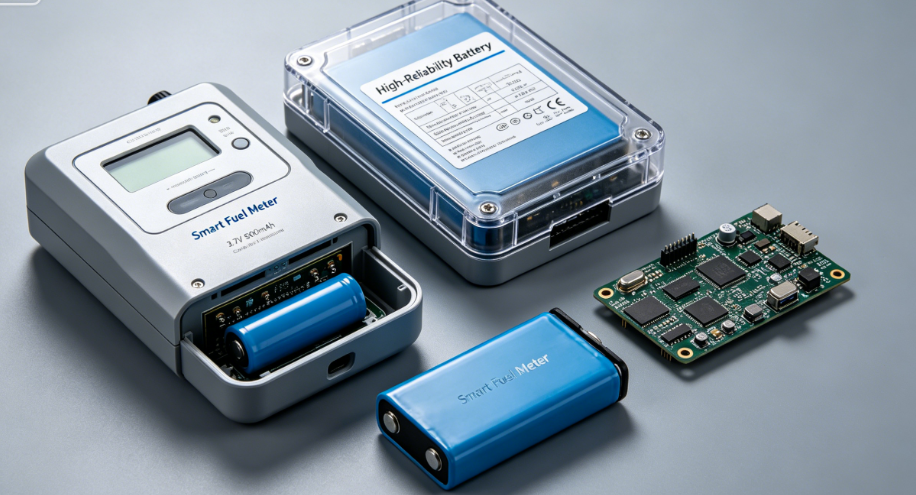
In the rapidly evolving landscape of the Industrial Internet of Things (IIoT), asset tracking and resource management have reached unprecedented levels of precision. Among these advancements, the traditional mechanical fuel gauge has transformed into the intelligent fuel meter—a sophisticated, connected device capable of real-time liquid level sensing, edge-data computing, and wireless long-range telemetry.
Today, these smart fuel meters are widely deployed across logistics networks, heavy construction machinery, remote generator sets, and industrial fuel storage tanks. However, because these devices are typically installed in remote locations without access to the electrical grid, their commercial viability hinges on one critical component: an autonomous, highly reliable, and long-lasting battery power source. Selecting the wrong power supply can lead to premature device failure, inaccurate readings, high maintenance costs, and catastrophic data gaps.
1. The Triple Challenge of Powering Smart Fuel Meters
Designing a power solution for intelligent fuel monitoring systems requires overcoming three severe environmental and operational hurdles:
- Extreme Environmental Gradients: Fuel tracking devices are completely exposed to the elements. A long-haul truck might travel from sub-zero arctic environments (-40°C) to scorching desert highways (+70°C) within a single week. Standard commercial batteries suffer from drastic capacity loss in extreme cold and accelerated self-discharge or leakage in high heat.
- The “Sleep-Wake” Duty Cycle: To conserve energy, smart fuel meters operate on a distinctive duty cycle. For 99% of the time, the device remains in a micro-ampere sleep mode, maintaining basic clock functions. However, at scheduled intervals, the microcontroller wakes up to sample fuel levels and activates high-power wireless modules (like NB-IoT or LoRa) to transmit data to the cloud. This data transmission requires instantaneous pulse currents ranging from hundreds of milliamperes to several amperes.
- Decade-Long Maintenance-Free Lifespan: Replacing batteries in thousands of fleet vehicles or remote oil depots introduces prohibitive labor and logistical expenses. Industrial operators expect these IoT devices to remain sealed and operational for 10 to 15 years without human intervention.
2. Li-SOCl₂ Chemistry: The Industrial Standard for IoT Metering
To address these severe constraints, industrial design engineers consistently turn to Lithium Thionyl Chloride (Li-SOCl) chemistry as the primary power source for smart meters. When evaluating the performance criteria of leading global manufacturers, Li-SOCl stands out as the most thermodynamically stable and energy-dense primary battery chemistry available today.
- Unparalleled Energy Density: With an energy density reaching up to 650 Wh/kg, Li-SOCl batteries pack maximum electrical capacity into the smallest possible physical footprint. This allows manufacturers to design compact, lightweight fuel sensors that can be easily integrated into tight tank geometries.
- Exceptionally Low Self-Discharge: High-quality Li-SOCl energy-type batteries exhibit a nominal annual self-discharge rate of less than 1% when stored at room temperature. This is achieved through a natural chemical phenomenon known as “passivation”—the formation of a protective lithium chloride film on the lithium anode. This film effectively halts spontaneous chemical reactions during sleep periods, preserving the battery’s energy for over a decade.
- Flat Voltage Discharge Profile: Unlike traditional alkaline or lithium manganese Li-MnO batteries, whose voltage drops steadily throughout their lifespan, Li-SOCl maintains a highly stable nominal operating voltage of 3.6V throughout 90% of its discharge cycle. This ensures that sensitive sensor electronics receive clean, consistent voltage, preventing calibration errors in fuel measurement.
3. Solving the Voltage Delay: The Battery + Capacitor Hybrid Solution
While the passivation layer gives Li-SOCl its legendary 15-year shelf life, it introduces a physical challenge known as voltage delay (voltage lag). When a smart fuel meter abruptly transitions from a long sleep state to a high-current data transmission state, the protective passivation layer restricts the initial flow of ions. Consequently, the battery voltage can momentarily drop below the device’s cutoff threshold, causing the meter to reset or fail during data transmission.
To eliminate this vulnerability, the industry utilizes an innovative hybrid topology: paralleling an energy-type Li-SOCl (ER) battery with a Hybrid Layer Capacitor (HLC) or Super Pulse Capacitor (SPC).
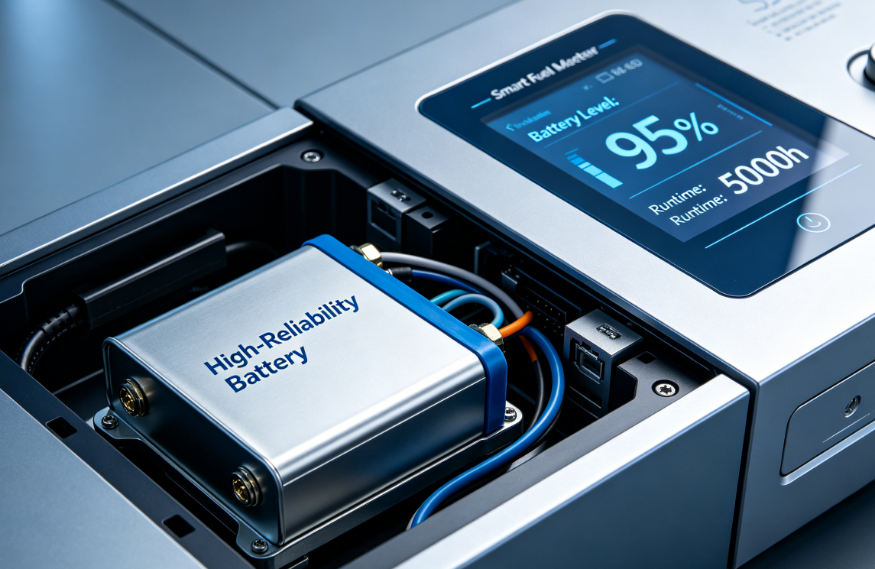
In this optimized configuration, the two components work in perfect synergy:
- The ER Battery as the Marathon Runner: The Li-SOCl battery acts as the long-term energy reservoir. It slowly and continuously tops off the parallel capacitor at a very low current, maintaining a low passivation state.
- The Capacitor as the Sprinter: When the fuel meter initiates a wireless transmission burst, the HLC/SPC instantly discharges, delivering the high pulse currents (up to several amperes) required by the RF transceiver.
This hybrid system effectively eliminates voltage delay, safeguards the electronics from transient voltage drops, and ensures stable, reliable data transmission under any temperature condition.
4. Manufacturing Quality and Global Compliance
In industrial business-to-business applications, a power solution is only as reliable as the quality control behind it. Premium battery manufacturers subject their industrial-grade primary lithium cells to rigorous testing and international certification processes.
For critical applications like fuel monitoring, cells must be fully compliant with CE, RoHS, UL, and UN38.3 regulations. These strict certifications guarantee that the batteries can withstand severe mechanical vibration (such as vehicle chassis vibration), thermal shock, and pressure changes without risking thermal runaway, leakage, or explosion—making them fully safe for hazardous explosive environments typically associated with fuel and oil storage.
Conclusion
As global logistics and industrial operations shift toward automated, data-driven management, the intelligent fuel meter represents a vital link in the supply chain. Providing these devices with a rugged, high-performance battery system is not merely an engineering choice; it is a strategic business decision. By combining the high capacity of Lithium Thiony Chloride chemistry with the pulse-power performance of advanced capacitors, operators can deploy smart fuel meters with total confidence, achieving maximum operational efficiency, a lower total cost of ownership, and an eco-friendly, long-term return on investment.


 English
  Français
  Español de México
  Deutsch
  Polski
  Italiano
  Русский
  한국어
한국어  Português